
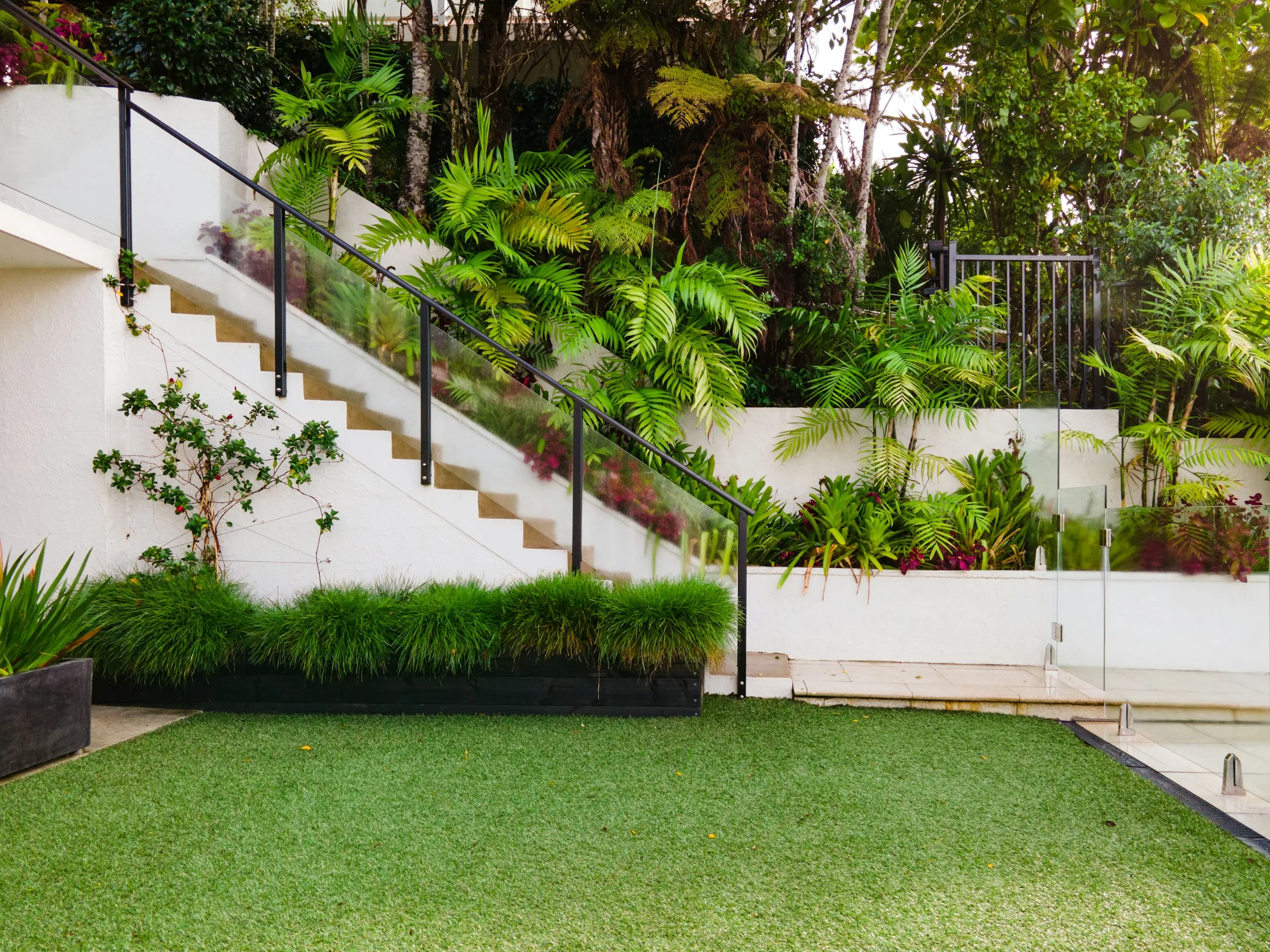
A useful artificial turf price answers two questions at once: what finished area are you buying, and what work is required to make that surface stable, drainable, cleanly edged, and suitable for the way your household will use it?
Installed turf cost is the whole assembly—not a roll of grass.
There is no responsible Salem total based on square footage alone. A quote may include removal of existing lawn or material, excavation, grading, compacted base, drainage-related work, turf, infill, seams, perimeter restraint, transitions, hauling, and restoration. Leave several of those items out and two estimates can look far apart while pricing different results.
Start with the total for a clearly defined scope. You can divide that total by the finished square footage to understand the effective installed rate, but use that number to compare genuinely similar proposals—not to predict an unmeasured yard from a national average.
Why 300 square feet is not always 30% of a 1,000-square-foot project.
Measurements matter, but small projects still carry work that does not shrink in direct proportion to the surface area. Delivery, equipment, setup, disposal, and the route into the yard all remain part of the day. A compact side yard may also have a high amount of edge work relative to its square footage.
Shape matters too. Curves, narrow strips, islands, posts, trees, utility covers, and multiple transitions can create more cutting and material waste than a simple rectangle. Ask whether the quote distinguishes the visible finished area from the quantity of turf and base material that must be ordered.
Measure the perimeter as carefully as the area.
A 400-square-foot rectangle and a 400-square-foot path network can require very different amounts of cutting, edge restraint, seams, and connection work.
Five parts of the quote deserve their own line of thought.
Removal and excavation
Existing grass, soil, roots, rock, or old surfacing may need to be removed and hauled away before the new elevation can be established.
Base and drainage
Grading, base depth, material, compaction, and water movement influence how the surface feels and performs. Shortcuts below the turf can become visible above it.
Turf and infill
Pile, density, backing, drainage characteristics, feel, heat exposure, and the selected infill should suit the intended use rather than appearance alone.
Seams, edges, and transitions
The layout should explain how turf meets paving, planting beds, fences, gates, drains, and existing grade—and where seams will fall.
Access, hauling, and restoration
Narrow gates, hand-carry distances, protected surfaces, disposal, cleanup, and repair of disturbed areas can change the labor around the installation.
The artificial turf service page offers a broader look at product fit, site preparation, drainage, edges, and routine care. Use this cost guide when the next decision is whether an estimate describes the complete work.
Water movement belongs in the price conversation.
In a Salem yard, look at what already happens during wet weather. Note puddles, soft areas, downspout discharge, slopes, low points, and water arriving from adjacent surfaces. Artificial turf does not make those conditions disappear; the proposed base, grade, and drainage approach should respond to the actual site.
Access can change with wet ground as well. Ask how materials and equipment will reach the work area, which nearby surfaces need protection, and whether seasonal conditions affect the schedule. The Salem landscaping overview connects artificial turf with the other yard systems that may meet it, including irrigation, hardscape, and fencing.
Pay for the surface your routine requires.
A pet area, play lawn, narrow side yard, decorative strip, and general gathering area do not ask the same things of turf. Pet use puts more emphasis on drainage and cleaning. Play or frequent foot traffic can shift priorities toward feel, durability, infill, and recovery. A highly visible but lightly used strip may put appearance first.
Sun exposure also matters because synthetic surfaces can become warm in direct sun. Shade patterns, the hours you plan to use the area, and neighboring paving should be part of the product conversation. Choosing for the application helps you avoid paying for features you do not need—or saving on a system that does not fit the use.
Put competing turf quotes on equal terms.
Before choosing the lowest total, check whether each proposal uses the same dimensions and includes the same responsibilities. A clear estimate should make these four comparisons possible:
Same footprint
Compare finished area, ordered material, shape, perimeter, seams, and transitions.
Same preparation
Compare removal, excavation, base depth and material, grading, compaction, and disposal.
Same turf system
Compare the named turf, backing, infill, drainage characteristics, intended use, and care guidance.
Same responsibilities
Compare access, delivery, edges, cleanup, restoration, exclusions, and how changes are approved.
Also ask whether any workmanship or manufacturer warranty applies, what it covers, how long it lasts, what is excluded, and what maintenance is required. Do not assume product coverage and installation coverage are the same.
Budget for care after installation.
Artificial turf trades mowing and seasonal growth for a different routine; it is lower-growth, not no-care. Leaves and debris still need removal. Pet areas need appropriate cleaning. Traffic paths may need brushing or infill attention, and edges, seams, and drainage paths should remain observable.
Ask for care guidance tied to the specific product and use. If you are comparing turf with keeping a living lawn, include both the upfront work and the maintenance each choice asks from you over time. For broader lower-maintenance planning, see how to plan a lower-maintenance Salem backyard.
Quick answers about artificial turf cost.
How much does 1,000 square feet of artificial grass cost?
Square footage alone cannot produce a reliable installed total. A 1,000-square-foot quote also depends on demolition, excavation, base depth, drainage needs, access, turf and infill selection, seam layout, edges, hauling, and restoration. Ask for a written scope and total rather than multiplying a national material price by 1,000.
How much is 300, 400, or 500 square feet of artificial turf?
Smaller areas are not always priced as a simple fraction of a larger lawn. Mobilization, delivery, equipment, disposal, edge work, and the number of cuts or seams can remain substantial even when the finished area is only 300, 400, or 500 square feet. The shape and site conditions matter alongside the measurement.
What should an artificial turf estimate include?
Look for the measured footprint; removal and disposal; excavation and grading; base materials and compaction; drainage-related work; turf product; infill; seams; edge restraint; transitions; delivery; cleanup; restoration; exclusions; and the process for approving a change. The quote should also identify whether taxes, permits, or other applicable fees are included.
Can artificial turf be installed over an existing lawn?
Artificial turf is a constructed surface, not a cover placed directly over living grass. The proposed assembly should account for removal, grading, a stable prepared base, drainage, edges, seams, infill, and transitions to nearby surfaces. The required preparation depends on the site and intended use.
Is artificial turf maintenance-free?
No. It removes mowing and seasonal growth, but leaves and debris still need removal, pet areas need appropriate cleaning, and high-traffic fibers or infill may need attention. Ask what routine care the selected turf system and application require.
Get an artificial turf estimate for your Salem-area yard.
Tell Willamette Valley Landscape how you want to use the area, share approximate dimensions and wide photos, and point out access, wet spots, slopes, pets, and the surfaces around it. That context is the start of a quote you can understand.